EntrLabs
Empowering Regional Innovation Ecosystem Resilience Through Co-evolution
Welcome to EntrLabs
Project NEXUS: Co-evolutionary Dynamics of Entrepreneurial, University, and Educational Ecosystems: Toward Resilient Regional Innovation Networks
Our Vision: Empowering Changemakers, Transforming Ecosystems
EntrLabs, founded by Joseph Eugene Iesue, exists to advance entrepreneurship education through cutting-edge research that integrates individual motivation, organizational learning, and ecological systems thinking. Our goal: to empower students and institutions to become engines of regional innovation, resilience, and community well-being.We envision a future where students, universities, and community partners co-create vibrant, inclusive entrepreneurial ecosystems—where every learner emerges as an innovative, socially responsible changemaker, and every region thrives on sustainable, knowledge-driven economic growth.
How Do We Track Progress?
We track our journey with rigor and transparency:
Yearly Research Milestones: A sequence of peer-reviewed articles are planned to coincide with coaching and mentorship services and digital newsletter resources, creating data-driven toolkits for each project phase. Initial articles will focus on university and workplace ecosystems, student and worker engagement, and entrepreneurship education.
Field-Validated Instruments: From achievement goal orientation to ecosystem engagement, measurement tools are developed, tested, and openly shared.
Collaborative "Living Labs": Action research, digital platforms, and mentorship interventions evaluated in real-world, multi-actor partnerships.
Impact Dashboards: Monitoring long-term technology, human resources, employment engagement trends, and creating policy and practical outcomes for students, communities, and policies, including resilience and equity metrics, well beyond GDP and grade performance.
How Are We Doing So Far?
Early wins: Foundational research confirms achievement goals and university culture matter for entrepreneurial service-learning participation, with validated scales now informing global studies.
Growing networks: Partnerships formed with faculty, community leaders, and corporate entities, looking to expand to innovation hubs; pilot living labs, and connecting underserved students and entrepreneurs.
Actionable insights: Early findings show that situational awareness and learning organization best practices both boost student engagement and ecosystem spillover effects.
What Are We NOT Doing?
Not limiting ourselves to theory; every project tests real-world pilot interventions, with policy and practice implications.
Not addressing entrepreneurship in isolation; instead, our multi-level model explicitly includes educational, institutional, and policy actors.
Not duplicating existing ecosystem studies; by integrating achievement goal theory, learning organization frameworks, and ecological approaches, EntrLab pioneers truly interdisciplinary solutions.
Not yet scaling to international replication—but charting the path to global impact.
What Have We Learned So Far?
Motivation matters: Mastery-oriented students are most open to entrepreneurial service.
Culture is catalytic: Learning organization dimensions can switch on or dampen willingness to engage.
Service-learning works: When rooted in ecological systems thinking, service experiences raise both situational awareness and participation in community innovation.
Barriers persist: Equity, access, and institutional inertia remain ongoing challenges needing intentional intervention.
How Can We Help Others?
We equip students, young professionals, educators, institutions (corporations and universities), policymakers, and communities with:
Evidence-based curriculum frameworks for entrepreneurship and service-learning
Practical toolkits for institutional cultural change and inclusive mentorship
Custom impact questionnaires: to provide real-time analytics for ecosystem health
Consultancy and professional workshops drawing directly on our latest research
What Help Do We Need?
Seeking faculty collaborators in business, education, and community engagement
Welcoming community organizations committed to student partnership and regional impact.
Recruiting graduate assistants and student researchers passionate about ecosystem resilience and entrepreneurship
Our Approach (The Research Arc)
Phase 1: Building individual and organizational foundations—expanding understanding of the motivational and cultural levers that spark engagement.
Phase 2: Growing real-world interventions—living labs, inclusive mentorship, and network mapping to activate true ecosystem co-evolution.
Phase 3: Scaling impact and informing policy—longitudinal studies, field-proven frameworks, and open-access tools for regional and international adoption.
Societal Impact & Long-Term Outcomes
Students: Real entrepreneurial and civic leadership skills for 21st-century change
Communities: Direct participation in knowledge exchange and innovation processes
Institutions: Adoption of ecology-driven, evidence-based entrepreneurship frameworks
Policy & Funding: Tested models for resilient, equitable regional economic growth
EntrLab’s impact echoes locally, inspires globally, and plants the seeds of resilient, inclusive innovation wherever learning and entrepreneurship meet.
Let’s co-create the future of engaged, resilient ecosystems, together.
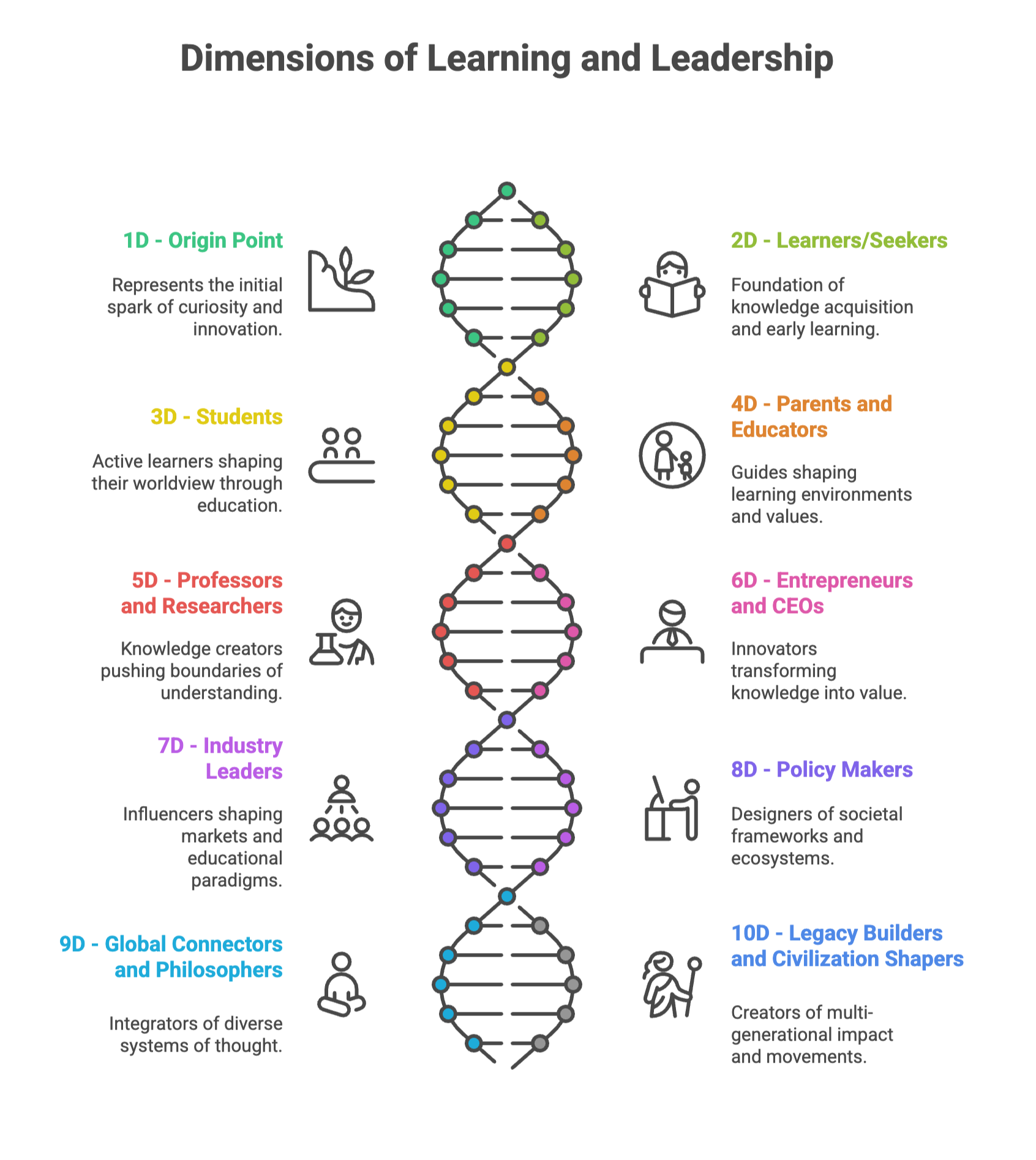
String Leadership Theory
This framework conceptualizes leadership and identity development as a journey up a metaphorical multidimensional mountain, drawing on analogies from M-theory (in which reality is structured by vibrating “strings” across multiple dimensions), musical resonance (as a metaphor for harmony and complexity of development), and established stages of psychosocial and career progression. Each “dimension” represents a qualitatively different plateau of awareness, agency, and interdependence. The model defines not only stage-appropriate tasks and leadership capacities, but also the mechanisms and limits of mentoring, the non-linearity of progression, and the recursive influence of higher stages on those below.
Stages of Career as Dimensions of Resonance